Affidavit: Chandler wants DNA collected from relative of one of two murder victims
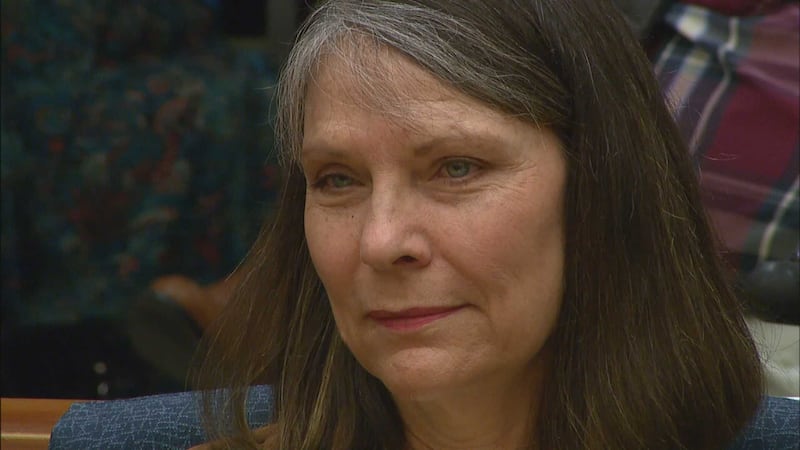
The research attorney representing defendant Dana Lynn Chandler, who is charged with two counts of murder in 2002, had asked the judge hearing Chandler's re-trial to order the collection of DNA samples from a man who is a relative of one of the victims and who the Chandler defense points to as an alternative suspect, court records released Monday said.
On Monday morning, Shawnee County District Court Judge William Ossmann ordered the release of a redacted copy of an affidavit, which had been sealed up to that point.
13NEWS obtained a copy of the affidavit on Monday morning soon after Ossmann released the document.
In the affidavit, Keen A. Umbehr, an attorney in the Chandler defense team, filed a 33-page affidavit asking Senior District Court Judge Robert Fairchild to issue a search warrant authorizing collection of three swabs from the mouth of a man who is related to a woman who was a victim in the 2002 slayings. The swabs would be used to obtain DNA, which can be compared to DNA evidence collected at the crime scene or from the victims. Umbehr filed the request on Aug. 18 for the DNA collection.
Fairchild, who is retired as a Douglas County District Court judge, is hearing the Chandler re-trial. Fairchild granted the court order to collect the DNA from the relative of one of the slaying victims.
The mouth swabs collected from the man would be compared to the DNA profiles obtained from forensic evidence recovered from the crime scene of the murders of Karen Harkness and Michael Sisco.
Chandler, 59, is charged with two counts of first-degree murder in the July 7, 2002, shooting deaths of her former husband, Sisco, 47, and Harkness, 53, in her west Topeka home.
In 2012, a Shawnee County District Court jury convicted Chandler of two counts of first-degree murder and she was sentenced to two 50-year prison terms. But the Kansas Supreme Court overturned the convictions based on prosecutorial misconduct.
Chandler, who is acting as her own defense attorney, remains in jail awaiting her retrial.
Umbehr, a licensed attorney who is acting as Chandler's research attorney, has supported the alternative suspect idea for years. Jason Belveal is acting as the standby counsel to Chandler.
Chandler's retrial originally was scheduled to start on September 16, but on July 24, the retrial date was postponed indefinitely until Chandler agrees she has finished filing motions. It was the fourth scheduled trial date for the Chandler retrial.
About two-and-a-half pages of information were blacked out with a marker.
Of that redacted material, ten paragraphs were "facts supporting probable cause for search warrant of" the man who is the relative of one of the victims.
The seven paragraphs that weren't redacted included that the man:
- Was a federal firearms license holder.
- "Presumably" he had a key to Karen Harkness' home because he was a member of the family.
- He lived about one hour from the murder scene.
- That Karen Harkness had asked him to review her financial documents about two months before the slayings.
- The man wasn't asked about his whereabouts on the night before the murders.
- Was a beneficiary in the will of Karen Harkness.
The documentation "clearly demonstrates that (the man) had the means, motive and opportunity to commit the murders of Michael Sisco and Karen Harkness," the affidavit submitted by Umbehr for the search warrant said.
The Umbehr affidavit said Chandler as well as the victims were eliminated as being the source of a hair attached to a 9mm shell casing.
Since Chandler was excluded as the source of DNA from the shell casing hair, "it is fair and reasonable for the court to grant Ms. Chandler's request for a search warrant for the (man), in an effort to undertake the necessary investigatory steps to identify the contributor of the DNA recovered from the shell located at the scene of the double murder," Umbehr said.
Umbehr said the only DNA samples originally collected came from Chandler and the two victims.
"The failure to carry out this fundamental investigatory protocol provides clear and convincing evidence that additional DNA testing is needed and warranted in order to establish the identity of the person whose limb hair was found attached to one of the spent shell casings recovered from the scene of the double homicide," Umbehr wrote.